In recent times I had a small issue with VMware vFabric tc Server which is included in SpringSource Tool Suite. When i was deploying my Spring application and after a long time i have this error :
"Server VMware vFabric tc Server Developer Edition v2.6 was unable to start within 120 seconds. If the server requires more time, try increasing the timeout in the server editor."


I would like to show you a professional CV in LaTeX of course ;) Below I put a screenshot of it.
 |
| CV in LaTeX Page 1/2 |
 |
| CV in LaTeX Page 2/2 |
Quite pretty, right ? ;)
So, If you would like to have this one CV on your own, just write to me via Contact page ;) I will generate CV for you for very very small gift ;)
I speak Polish, so I wondering why not put some helpful information related with polish fonts in LaTeX. At the beginning I have to say that is very simple to do ;)
If you use Windows put :
\usepackage{polski}
\usepackage[cp1250]{inputenc}
If you use Linux put :
\usepackage{polski}
\usepackage[latin2]{inputenc}
If you use MacOS put :
\usepackage{polski}
\usepackage[macce]{inputenc}
Simple, isn't it?
Reference :
[1] Polonizacja LaTeX [PL]
[2] LaTeX Quide [PL]

In this post I would like to present Perl script for Nagios that can check HSRP state of Cisco host(s) in network using SNMP protocol (only version 3) and return an output about error level (OK, Warning or Critical) related to Nagios.
Main table in MIB where all information related with HSRP state are stored is cHsrpGrpTable, where are many cHsrpGrpEntry objects which correspond with HSRP groups configured on router and each of them contains configuration and status related with this Cisco protocol.
Example snmpwalk over HSRP information in MIB :
SNMPv2-SMI::enterprises.9.9.106.1.2.1.1.2.1.1 = STRING: "pr0jekt"
SNMPv2-SMI::enterprises.9.9.106.1.2.1.1.3.1.1 = Gauge32: 105
SNMPv2-SMI::enterprises.9.9.106.1.2.1.1.4.1.1 = INTEGER: 1
SNMPv2-SMI::enterprises.9.9.106.1.2.1.1.5.1.1 = Gauge32: 0
SNMPv2-SMI::enterprises.9.9.106.1.2.1.1.6.1.1 = INTEGER: 2
SNMPv2-SMI::enterprises.9.9.106.1.2.1.1.7.1.1 = Gauge32: 0
SNMPv2-SMI::enterprises.9.9.106.1.2.1.1.8.1.1 = Gauge32: 0
SNMPv2-SMI::enterprises.9.9.106.1.2.1.1.9.1.1 = Gauge32: 3000
SNMPv2-SMI::enterprises.9.9.106.1.2.1.1.10.1.1 = Gauge32: 10000
SNMPv2-SMI::enterprises.9.9.106.1.2.1.1.11.1.1 = IpAddress: 10.102.33.1
SNMPv2-SMI::enterprises.9.9.106.1.2.1.1.12.1.1 = INTEGER: 1
SNMPv2-SMI::enterprises.9.9.106.1.2.1.1.13.1.1 = IpAddress: 10.102.33.253
SNMPv2-SMI::enterprises.9.9.106.1.2.1.1.14.1.1 = IpAddress: 10.102.33.254
SNMPv2-SMI::enterprises.9.9.106.1.2.1.1.15.1.1 = INTEGER: 6
SNMPv2-SMI::enterprises.9.9.106.1.2.1.1.16.1.1 = Hex-STRING: 00 00 0C 07 AC 01
SNMPv2-SMI::enterprises.9.9.106.1.2.1.1.17.1.1 = INTEGER: 1
The properly way to examine HSRP state is iterate through SNMP interface ID and HSRP group ID (this in one before last and last one digit from above OID for example 1 and 1), but this script skip this step and only fetch information from cHsrpGrpStandbyState parameter ;) :
2: learn
3: listen
4: speak
5: standby
6: active
print this help message
-u --username=USERNAME
-a --authprotocol=PROTOCOL
protocol for auth e.g. SHA
-A --authpassword=PASSWORD
password for auth
-x --privprotocol=PROTOCOL
protocol for auth e.g. DES
-X --privpassword=PASSWORD
password for auth
-H --hostname=HOST(s)
name or IP address of host(s)
-S --switch=SWITCH
name or IP address of switch


Reference:
[1] Cisco HSRP Documentation
[2] Pierky blog
[3] Source GitHub
A lot of open and neutral API (Application Programming Interface) have been created in recently years which were designed to facilitate access to the functionality of telecommunications networks.
Organizations 3rd Generation Partnership Project (3GPP) and European Telecommunications Standards Institute (ETSI) started joint work on assumptions of new service architecture called Open Service Architecture (OSA). Also Sun Microsystems designed specification of their own interface for telecommunication sector called Java APIs for Integrated Networks (JAIN).
Finally, organizations Parlay Group and ETSI with 3GPP focused joint efforts on designing unified interface Parlay/OSA for telecommunication sector which support concept of developing new service platform for telecoms.
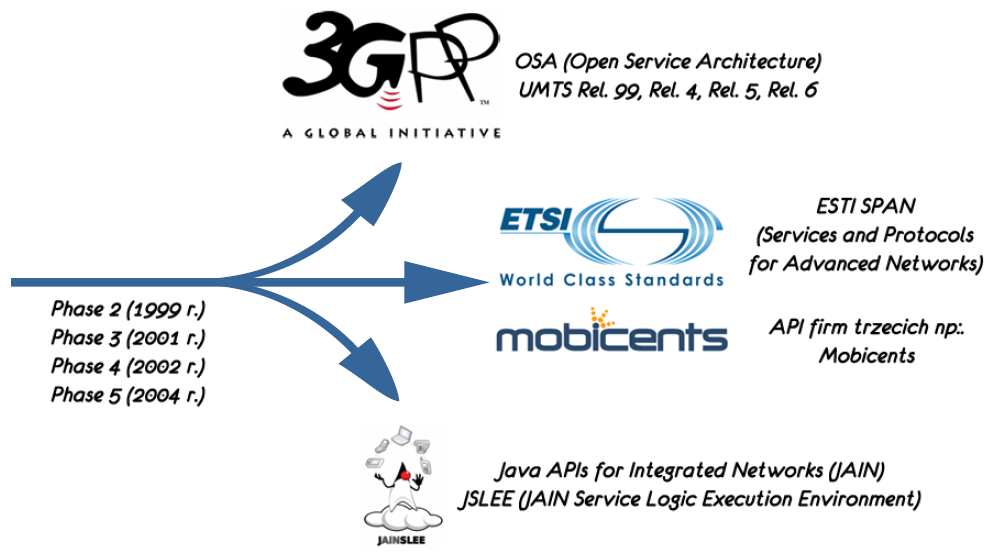 |
| Evolution of Application Programming Interfaces in Telecommunications |
Reference :
[1] Java APIs for Integrated Networks
[2] ETSI Parlay
[3] 3GPP
It all started with a process called convergence, which was initiated in the early 90' mainly by technical progress, when telecoms decided to implement in their internal systems intelligent platforms, which allowed them using it to provide integrated and innovative services. Highly simplified model is presented on picture below. Through this process was created a new 'technology branch' called Information and Communication Technologies (ICT).
Due to this occurence were created many solutions which connect (mashup) internet technologies like the Internet, e-mails, digital maps e.g. with functionalities of mobile networks like voice and text services to finally get new products like SMS Gateway, protocols to transmission videos Video over IP (VIP) and sound Voice over IP (VoIP), multiline telephone systems PBX, protocol WAP, digital TV (DVH-B) and many many more. Also this process had a great impact on the assumptions of Telco 2.0.
 |
In result of synergy of telecommunication and IT sector occurred some new directions of development in future :
- Internet will become a new medium for transport of phone calls etc.
- Mobile networks gain hegemony in relation to fixed networks
- Band telecommunications networks will be dominated mainly by the movement ICT
Thanks to convergence, telecoms changed conception of creation services from strictly related with telecommunication to tools and solutions derived from IT sector.
 |
| Technologies in Telecommunications |
Reference :
[1] Technologies of the future in telecommunications [PL]
[2] The development of telecommunications and mail in the information society [PL]